Project page · August 2026

EditBridge

Towards Faithful and EfficientUltra-High-Resolution Image Editing

Jiayi Song1,2Shijie Huang2Fangtai Wu2Yubo Huang2Zhenxiong Tan3Songhua Liu1,*Jiaming Liu2,†Ruihua Huang2

1School of Artificial Intelligence, Shanghai Jiao Tong University2Qwen Business Unit of Alibaba3National University of Singapore

*Corresponding authorProject lead

liusonghua@sjtu.edu.cn

4Kediting resolution
61.1s4K inference
3.6–8.4×2K speedup
1 stepbridge refinement

Why EditBridge

High-resolution editing without losing the source.

Challenge

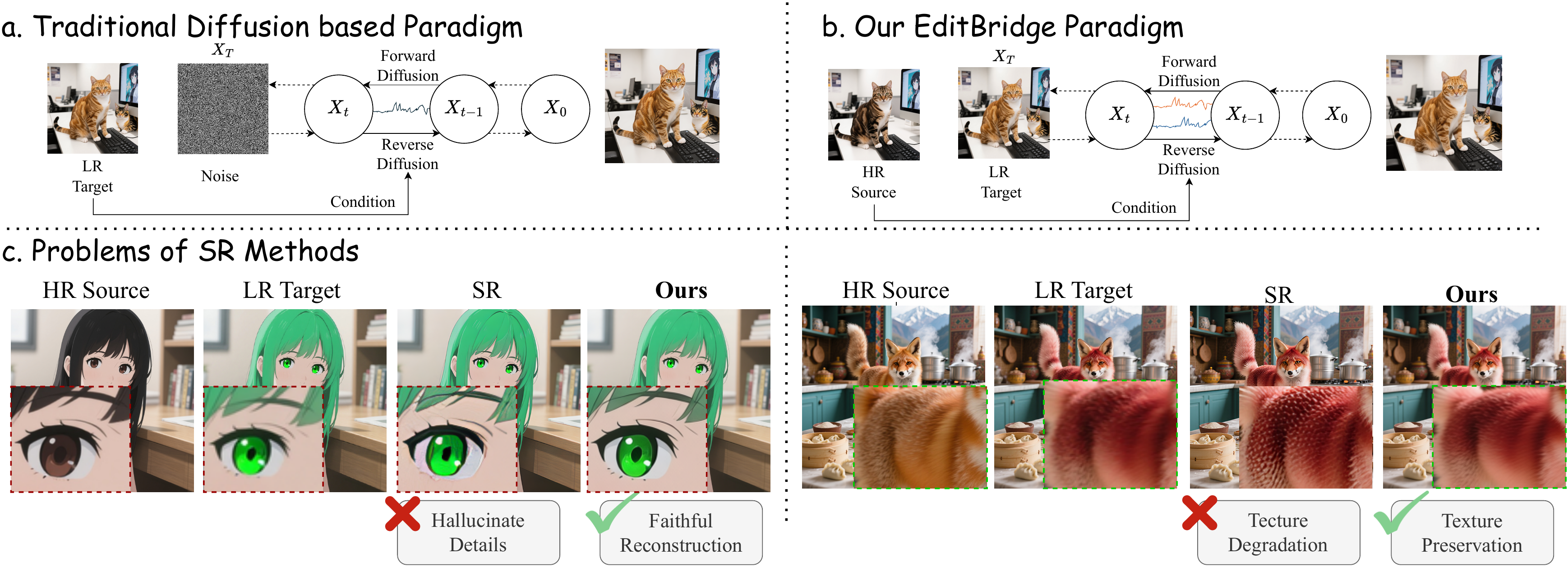
Existing diffusion editors are usually limited to sub-1K outputs. A low-resolution edit followed by independent super-resolution can hallucinate details or damage texture because the original high-resolution source is no longer available to guide refinement.
Our approach

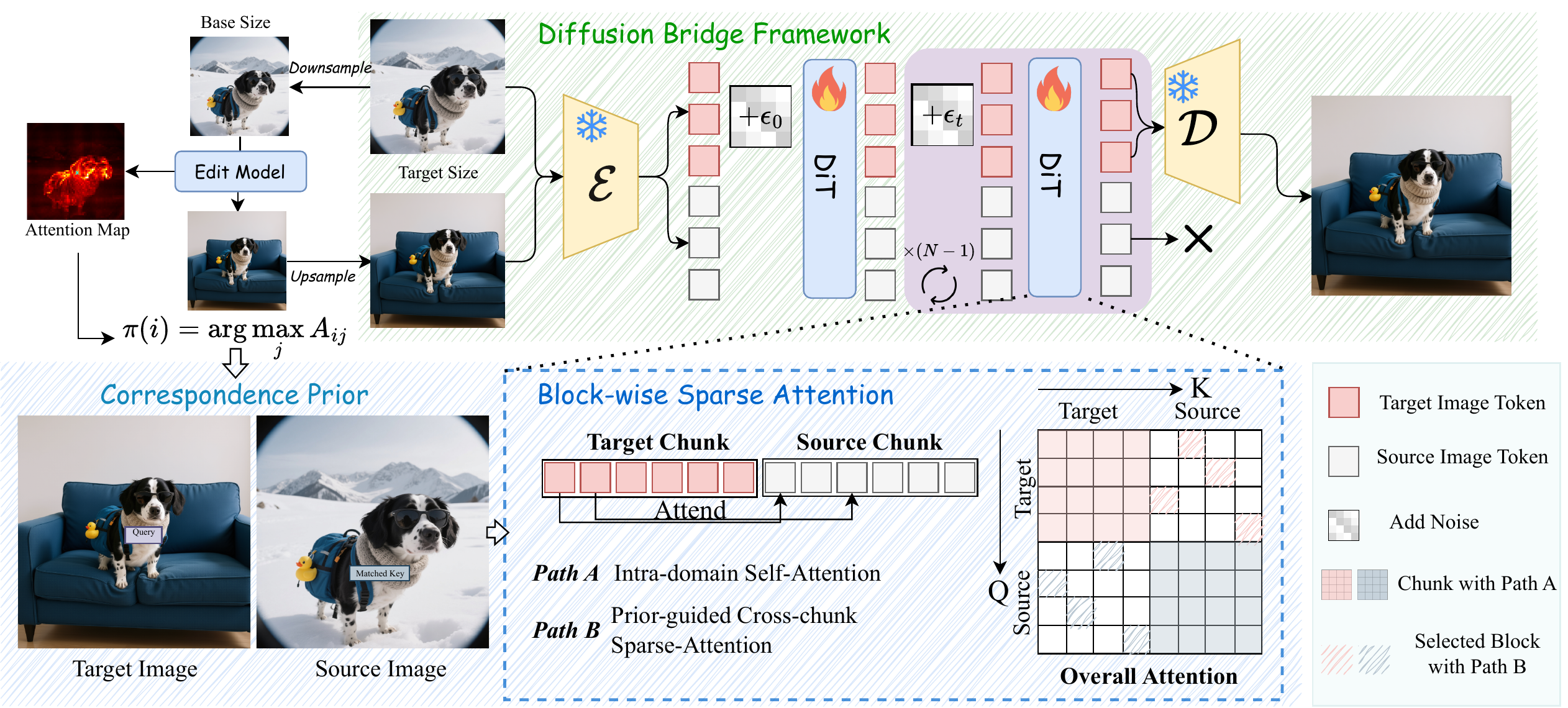
EditBridge reframes refinement as a structured data-to-data diffusion bridge from the low-resolution edited result to its high-resolution counterpart. The original high-resolution image remains an explicit condition, while prior-guided block-wise sparse attention preserves aligned details without the cost of dense global attention.

Traditional diffusion and EditBridge pipelines, with examples of hallucinated details and texture preservation.
Motivation. EditBridge conditions refinement on the original HR source, preventing information divergence and texture degradation.

Method

A bridge from coarse edits to faithful 4K results.

A diffusion bridge transports the upsampled LR edit toward the HR target. Correspondence priors from the first-stage editor route each target chunk to semantically aligned source blocks.

EditBridge framework with diffusion bridge refinement, correspondence prior, and block-wise sparse attention.
Overview of EditBridge. PG-BSA combines intra-domain self-attention with prior-guided cross-chunk sparse attention.
01

Coarse edit

A pretrained editor first produces an instruction-aligned result at its native resolution.

02

Diffusion bridge

The upsampled edit becomes a structured starting point instead of regenerating the image from noise.

03

Sparse HR guidance

Semantic correspondence selects only the source blocks needed to recover faithful high-frequency detail.

Results

Sharper details, stronger fidelity, practical latency.

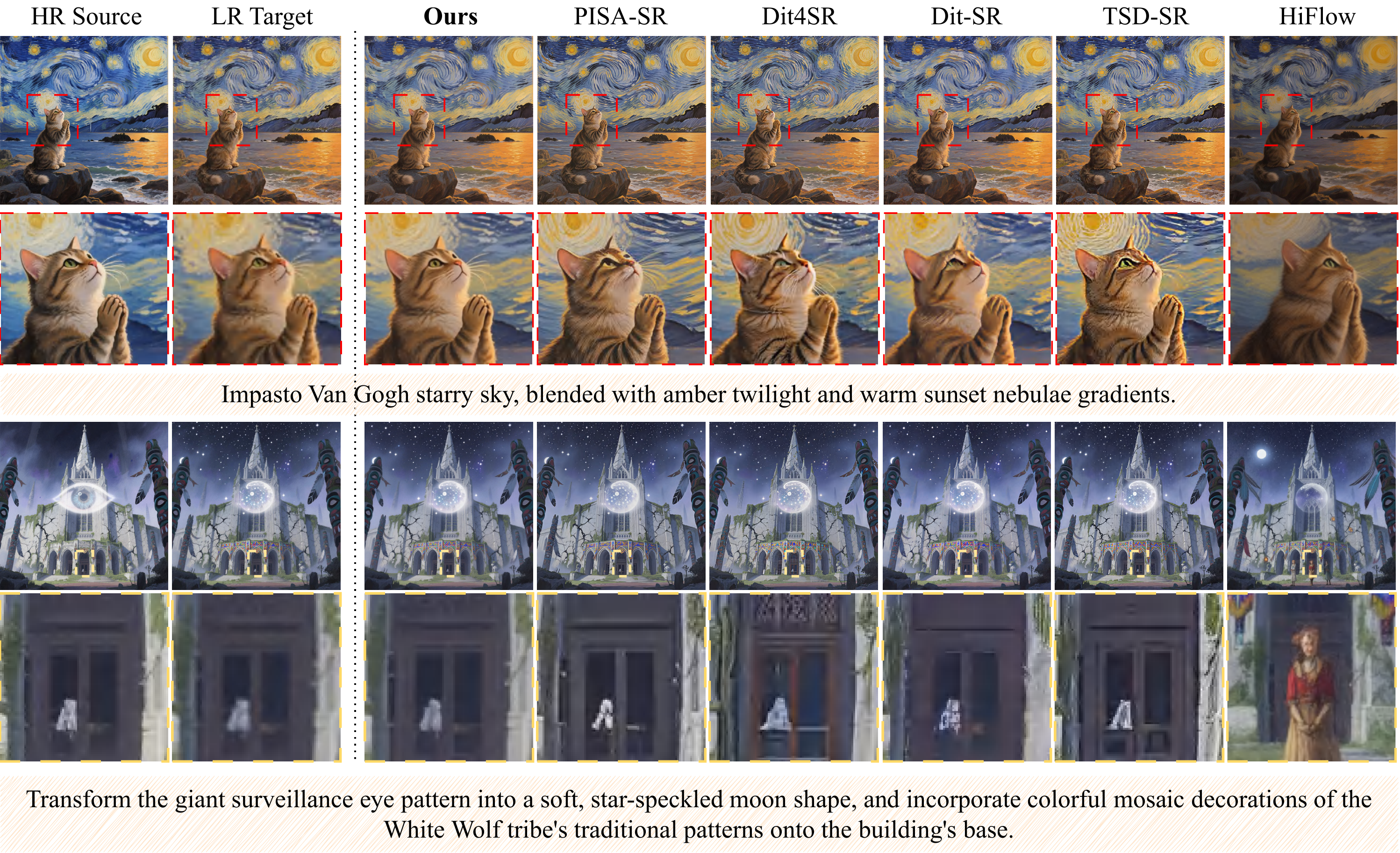
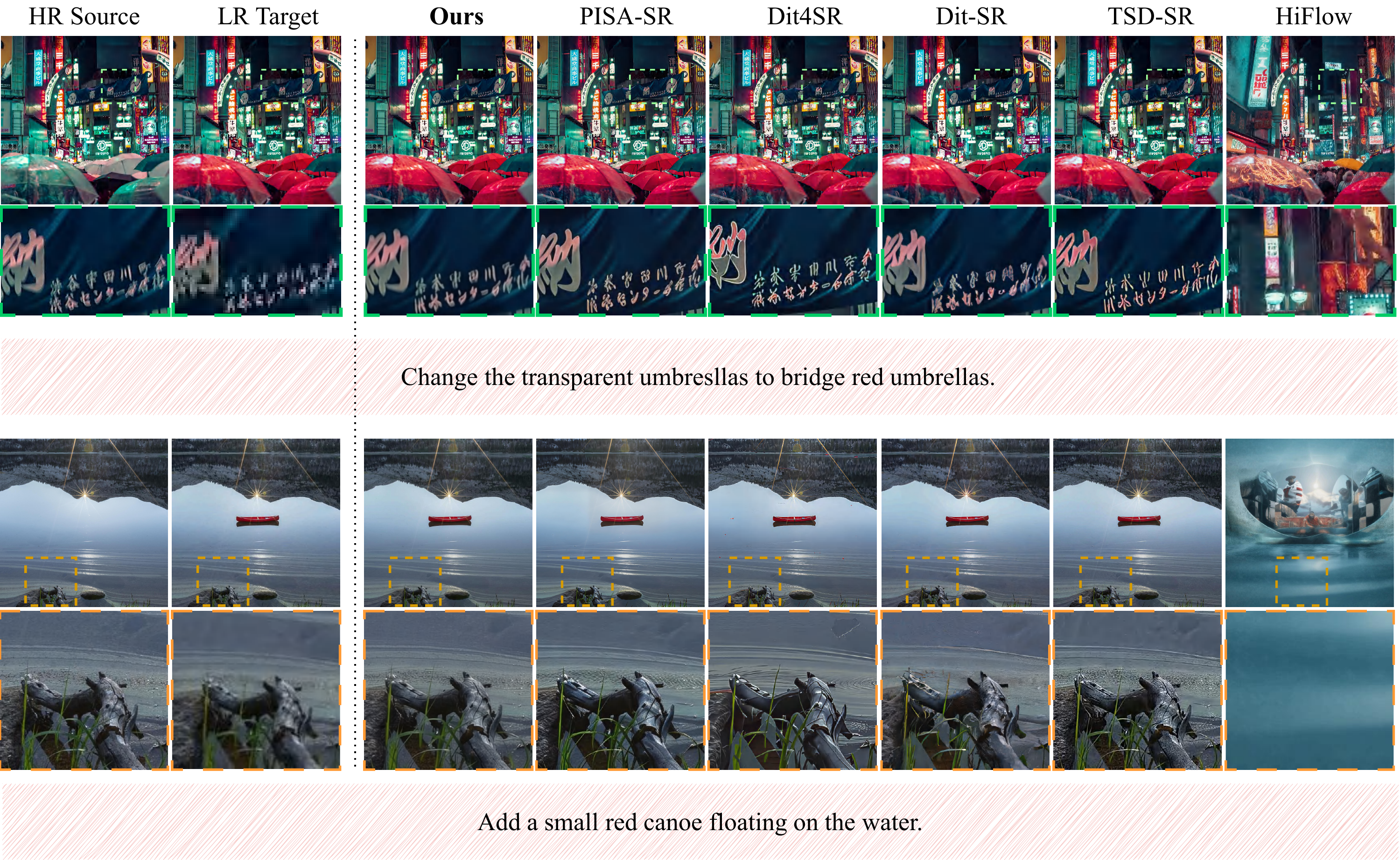
EditBridge consistently leads reconstruction and perceptual metrics from 1K through 4K while remaining substantially faster than direct inference and conventional diffusion-based super-resolution.

Qualitative 1K comparison across EditBridge and baseline super-resolution methods.
Qualitative comparison at 1K. Ours recovers fine details while remaining faithful to the HR source.
Qualitative 2K comparison across EditBridge and baseline super-resolution methods.
Qualitative comparison at 2K. EditBridge preserves text, object structure, and local texture.

Analysis

One step is enough.

Visual comparison between full attention and EditBridge sparse attention.
Attention sparsity. Full attention introduces source-induced artifacts; PG-BSA preserves alignment.
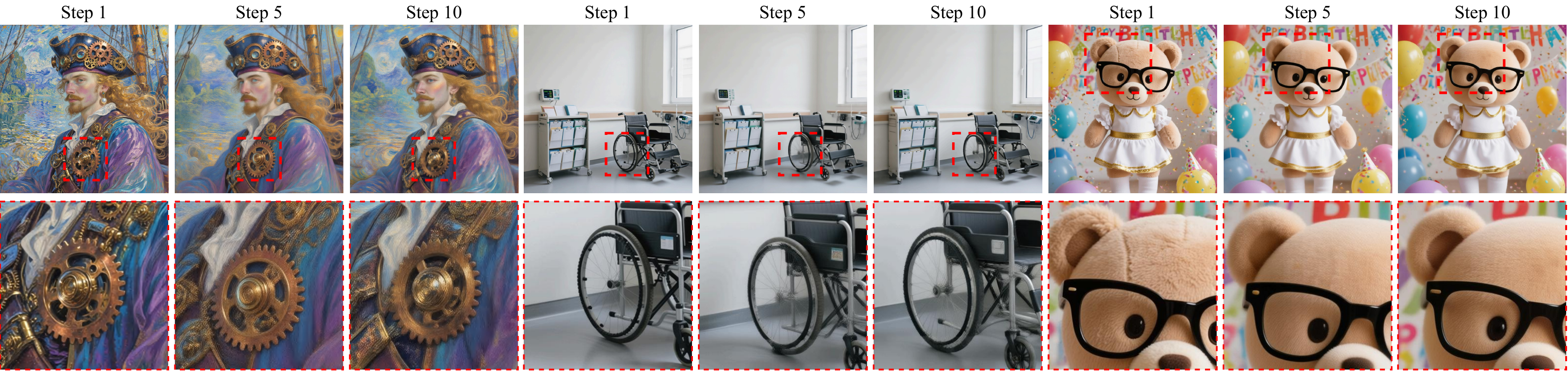
Comparison of one, five, and ten bridge inference steps.
Sampling steps. Single-step inference gives the best fidelity–efficiency balance.